Entete 3

Category Archives: Others

Looking for a consensus for a definition of multimorbidity: the results

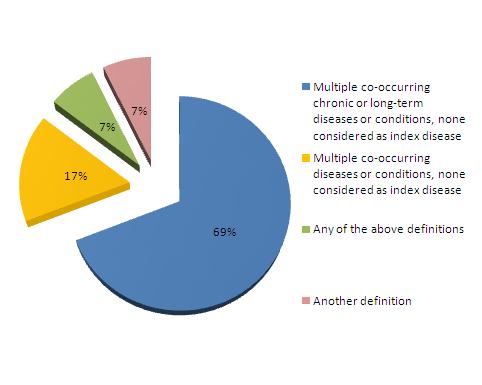
We have computed the results of the survey we conducted recently on the definition of multimorbidity.

We received 55 responses from 16 countries. The distribution of respondents by country (in alphabetic order) was: Australia 4, Brazil 1, Canada 10, China 1, Egypt 1, Germany 1, India 1, Indonesia 1, Ireland 6, Netherlands 4,  South Korea 1, Spain 6, Switzerland 1, Turkey 1, United Kingdom 10 (3 of them from Scotland), United States of America 6.

Answers to the question “which definition do you think should be used for multimorbidity?” were as follows:

Comments associated with the responses to the last item are shown below as replies to this posting. We welcome more comments on this subject that can also be written as replies to the posting.

We want to thank all participants who shared their view on this subject.

The International Research Community on Multimorbidity

Rethinking health outcomes in the era of multiple concurrent chronic conditions


By Ross Upshur, Kerry Kuluski and Shawn Tracy

Outcomes are broadly considered to be the results brought about by care delivered to patients by healthcare providers. The increased focus on outcomes is understandable given the vast resources our society now devotes to health care. Outcomes that are typically measured relate to the management of specific diseases such as cancer, cardiovascular disease, and other common chronic diseases such as diabetes, osteoarthritis, and depression. On the other hand, Canadian health care systems tend to focus on outcomes that relate to the efficiency and cost effectiveness of the health care system. However, these outcomes may be missing an important phenomenon that is occurring before our eyes: multi-morbidity, or multiple concurrent chronic disease (MCCC).

This is the subject of a post authored by Ross Upshur, Kerry Kuluski and Shawn Tracy recently published in the healthydebate.ca blog. We would like to invite the readers of this blog to follow this link to read the whole text.

Polypharmacy patterns: unravelling systematic associations between prescribed medications


By Amaia Calderón and Alexandra Prados-Torres

We would like to share with you an article recently published in PLOS ONE [1] by our research group, EpiChron. The study demonstrates the existence of non-random associations in drug prescription, resulting in patterns of polypharmacy that exist in a significant proportion of the population. We believe that the information discovered would further the development and/or adaptation of clinical patient guidelines to patients with multimorbidity who are taking multiple drugs.

[1] Calderon-Larranaga A, Gimeno-Feliu LA, Gonzalez-Rubio F, Poblador-Plou B, Lairla-San Jose M, Abad-Diez JM, Poncel-Falco A, Prados-Torres A. Polypharmacy Patterns: Unravelling Systematic Associations between Prescribed Medications. PLoS One. 2013;8(12):e84967.

A Commentary on the U.S. HHS Initiative, Multiple Chronic Conditions: A Strategic Initiative. A Special Issue of the Journal of Comorbidity


By William A. Satariano and Cynthia M. Boyd

“Multiple Chronic Conditions:  A Strategic Framework” is a seminal report and the heart of a US strategic initiative, released by the U.S. Department of Health and Human Services (HHS) in December 2010.  The purpose of the special initiative is to focus the attention and resources of the US government on the research, practice, and policy implications of multiple chronic conditions (MCCs) [1].   The Journal of Comorbidity (JoC) recently published a special issue to consider the MCC report from a broader international perspective, to our knowledge, the first scientific journal to do so [2].
As co-editors of the special issue, we, together with Sandra Cox, the JoC Senior Editor, invited a team of international scholars to respond to the MCC report, as summarized for the special issue by Anand K. Parekh and Richard A. Goodman from the US HHS.  Both Parekh and Goodman were instrumental in the development of the MCC report; and, we thought, uniquely qualified to summarize, for our purposes, the key research objectives of the special initiative.
Each scholar was asked to address one of the key research objectives of the MCC report and, whenever possible, to highlight some of the current research, practice, and policy from their home countries.  The scholars and their topics are Martin Fortin and Susan M. Smith (Canada and Ireland), Improving the external validity of clinical trials:  the case of multiple chronic conditions; Francois G. Schellevis (the Netherlands), Epidemiology of multiple chronic conditions:  an international perspective; Jose M. Valderas (United Kingdom), Increasing clinical,, community, and patient-centered health research for preventing and managing multimorbidity; and Efrat Shadmi (Israel), Disparities in multiple chronic conditions within populations.
We believe that the JoC special issue underscores the importance of international collaboration for a better understanding of both the common and unique themes associated with the global impact of MCCs.  We trust that this special issue will help to simulate further research, discussion, and guidance to that end.

[1] U.S. Department of Health & Human Services.  Multiple chronic conditions:  A strategic framework.  Optimum health and quality of life for individuals with multiple chronic conditions.  Washington, DC:  U.S. Department of Health & Human Services; 2010. Available from:  http:www.hhs.gov/ash/initiatives/mcc/mcc_framework.pdf

[2] Special Issue:  A commentary on the U.S. HHS Initiative, Multiple Chronic Conditions:  A strategic initiative.  Journal of Comorbidity2013;3(2):18-50.  Available from:  http:www.jcomorbidity.com/index.php/test/issue/current/showToc

HAPPY HOLIDAYS 2014

Quality indicators for functional status and quality of life in people with multimorbidity: Are we ready?


Sydney Dy, Elizabeth Pfoh, and Cynthia Boyd

Patients with multimorbidity suffer from multiple concurrent diseases that may affect their functional status and quality of life. Quality measurement that incorporates functional status and quality of life domains could be a valuable approach to complement the many disease-centered quality measures, and might help guide improvement in care. However, since multiple factors can influence functional status and quality of life, incorporating these outcomes into measures of the quality of health care may be challenging, especially in the population with multimorbidity.  To address this concern, we published a review in the Journal of the American Geriatrics Society [1] that aimed to inform initiatives that are developing quality indicators addressing functional status and health-related quality of life for patients with multimorbidity.  

We reviewed key sources of indicators (such as the National Quality Forum and Agency for Healthcare Research and Quality) to find quality indicators for quality of life and functional status relevant to this population in the outpatient arena. We also interviewed key informants who are using these outcomes in quality indicator projects that include or focus on the population with multimorbidity.

We found few relevant quality indicators for people with multimorbidity; existing indicators are used only for specific populations or settings, are challenging to implement, and have issues with validity. Key informants discussed concerns about the validity of existing indicators for differentiating quality of care between systems, and concerns about their use in a population where physical function for many people is naturally declining over time. Additionally, they raised concerns about consistent documentation for these quality indicators across providers.  Another challenge is defining the appropriate sampling population for the indicators.  

Across countries, quality measurement is used for varied purposes, ranging from financial incentives to accountability and quality improvement.  Avoiding unintended consequences through the use of such quality indicators is essential, as it may be most challenging to improve these outcomes in the most vulnerable populations.  Fundamental to the consideration of using quality indicators that focus on functional status and quality of life is improving the evidence base for how to improve these outcomes for people with multimorbidity – and this is still a limited, albeit growing, evidence base.

A potential first step to better integrate these outcomes into quality initiatives might be to implement standards for infrastructure to routinely collect this data from patients in clinical care.

1. Dy SM, Pfoh ER, Salive ME, Boyd CM. Health-Related Quality of Life and Functional Status Quality Indicators for Older Persons with Multiple Chronic Conditions. Epub, J Am Geriatr Soc. 2013 Dec 9.

Interventions for people with multimorbidity


By Susan Smith

The limited evidence of the effectiveness of interventions for people with multimorbidity means that there is a need for much more research and trials of potential interventions [1]. We have just published a paper in the Journal of Comorbidity presenting a consensus view from a group of international researchers working to guide future studies of interventions to improve outcomes for people with multimorbidity [2]. We suggest that there is a need for careful consideration of whom to include, how to target interventions that address specific problems and that do not add to treatment burden, and selecting outcomes that matter both to patients and the healthcare system. Innovative design of these interventions will be necessary as many will be introduced in service settings and it will be important to ensure methodological rigour, relevance to service delivery, and generalizability across healthcare systems.
I would welcome any contact from research teams conducting evaluations of interventions for multimorbidity as these could potentially be included in the next update of the Cochrane Review of such interventions.

[1] Smith SM, Soubhi H, Fortin M, Hudon C, O’Dowd T. Interventions for improving outcomes in patients with multimorbidity in primary care and community settings. Cochrane Database Syst Rev (2):CD003638. 2012;4:CD006560.
[2] Smith SM, Bayliss EA, Mercer SW, et al. How to design and evaluate interventions to improve outcomes for patients with multimorbidity. Journal of Comorbidity. 2013;3:10-17.

Incorporating comorbidity interrelatedness into clinical practice, research, and policy

By Donna Zulman

Multimorbidity is an increasingly recognized challenge to quality improvement and cost-containment efforts for healthcare systems. In order to optimize interventions and policies addressing multimorbidity, we must have a clear understanding of the relationship between multimorbidity and quality of care. In a recent article in the Journal of General Internal Medicine [1], we review the literature on multimorbidity and quality of care, the majority of which has focused on how clinical care is affected by a patient’s number of chronic conditions and specific characteristics of those conditions (e.g. symptom intensity, clinical dominance). We suggest that quality of care for patients with multiple chronic conditions is also likely influenced by comorbidity interrelatedness, or the degree to which conditions interact to affect clinical management.
 
 While comorbidity interrelatedness is a familiar concept to many clinicians, there is a need to more formally integrate this construct into research, clinical support tools, and quality metrics. In our article, we introduce a framework for multimorbidity that incorporates comorbidity interrelatedness, as well as traditional concepts of comorbidity count and characteristics. We describe how each of these constructs can generate clinical complexity and influence quality of care. Finally, we provide recommendations for operationalizing the concept of comorbidity interrelatedness, and incorporating this construct into clinical practice, research, guideline development, and performance metrics and reimbursement.


[1] Zulman DM, Asch SM, Martins SB, Kerr EA, Hoffman BB, Goldstein MK. Quality of Care for Patients with Multiple Chronic Conditions: The Role of Comorbidity Interrelatedness. J Gen Intern Med. Oct 1 2013.

GPs’ perspectives on the management of patients with multimorbidity

By Carol Sinnott

Our research group has recently published a systematic review of the existing published literature on the perceptions of general practitioners (GPs) or their equivalent on the clinical management of multimorbidity [1].

Article focus:
• Patients with multiple morbidities present unique challenges to healthcare providers. An awareness of these challenges is needed to direct research efforts and intervention design in this field.
• Qualitative studies have explored GPs perceptions of the management of multimorbid patients, but to date these studies have not been systematically reviewed or synthesized.

Key messages:
• This systematic review shows that the problem areas for GPs in the management of multimorbidity may be classified into four domains: disorganization and fragmentation of health care; the inadequacy of guidelines and evidence based medicine; challenges in delivering patient centred care; and barriers to shared decision making.
• These domains may be useful targets to guide the development of interventions that will assist and improve the provision of care to multimorbid patients.

Strengths and limitations:
• The meta-ethnographic approach used in this review gave a broader understanding of the challenges of multimorbidity than any single study, while still preserving the context of included studies.
• We focused on the GPs’ perspective on multimorbidity – an understanding of the challenges experience by patients is also required to inform the development of effective interventions. 

The complete article can be accessed at:
http://bmjopen.bmj.com/cgi/content/full/bmjopen-2013-003610

 
[1] Sinnott C, Mc Hugh S, Browne J, Bradley C. GPs’ perspectives on the management of patients with multimorbidity: systematic review and synthesis of qualitative research. BMJ Open. 2013;3(9):e003610.

Publications on multimorbidity January – April 2013

By Martin Fortin

Our search for papers on multimorbidity that were published during the first quarter of this year has been completed. As in previous searches, we found many new papers and the list is too long for this venue. Therefore, we have prepared a PDF file that can be accessed following this link.

Probably, there are some papers that were not detected by our search strategy using the terms “multimorbidity”, “multi-morbidity” and the expression “multiple chronic diseases”, but we are sure that most publications on the subject are included in the list.

All references are also included in our library. Feel free to share with anyone interested in multimorbidity.